Whisiler Painting Peter Paul Biro Forensic Studies in Art
Forensic fine art analyst Peter Paul Biro, the subject area of a 2010 exposé in the New Yorker, is suing the magazine'due south publisher for defamation to the tune of $2 million. In the profile, reporter David Grann, who is also a accused in the accommodate, suggests that Biro may have fabricated some of the fingerprints he "discovered" on clients' paintings, including a contested Jackson Pollock canvas, in social club to falsely authenticate them. While the thought of an accused fingerprint fabricator suing a journalist for fabrication would brand for great poetic justice, Biro's 31-page federal complaint, filed Midweek, sounds more like sour grapes than quid pro quo.
Biro calls the 16,000-word commodity "a false and defamatory screed against the plaintiff, written and published with malice and indifference to the standards of responsible journalism," according to selections of the complaint published by Courthouse News Service. David Remnick, editor of the New Yorker (which, information technology should be mentioned, is known for running i of the virtually sophisticated fact-checking operations in the biz), stood by the story. He told AdWeek that Grann's reporting was "painstaking in both its attention to the facts and tone." Biro is also suing Dan Rattiner, author of a follow-up article in the weekly Hamptons paper Dan's Papers, for the same amount.
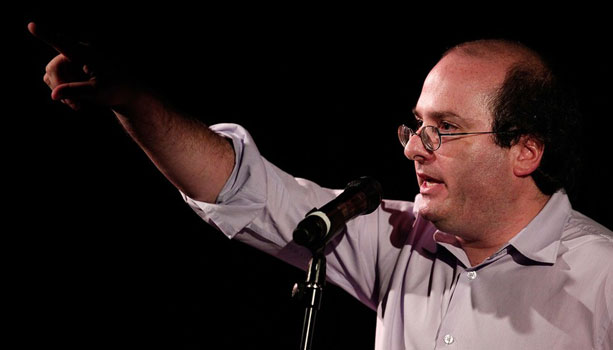
David Grann, writer for the The New Yorker /Joe Kohen / Getty Images North America
Before the contested New Yorker profile, Montreal-based Biro was best known as the hero of the 2006 documentary "Who the #$&% Is Jackson Pollock?" The film follows 73-year-quondam quondam truck driver Teri Horton on her quest to authenticate a painting she bought at a austerity shop as an original Jackson Pollock. Former Met director Thomas Hoving -- cast in the film as the pompous antagonist -- and other experts ridiculed the attribution. But Biro saved the day: using a multispectral camera, he matched a fingerprint on the painting with that on a can of paint in Pollock's studio. At the end of the film, Horton turns down a $9 one thousand thousand offer for the painting, holding out for the $50 million she'south certain it'south worth, thanks to Biro's research.
Grann's article casts Biro in a strikingly unlike low-cal. After consulting well-respected forensic experts and uncovering Biro's involvement with a series of unsavory lawsuits, the reporter arrived at a revelation scarcely seen exterior of Sherlock Holmes novels. Was information technology possible that Biro forged the fingerprints? Working off the paradigm of a print Biro used to authenticate another Pollock painting, crime lab worker Pat A. Wertheim discovered several aspects that were inconsistent with normal fingerprints but matched the cast of a fingerprint he made from a paint tin can in Pollock's studio. Though the Pollock in question was not the one featured in the 2006 documentary, the suggestion was plenty to practice more than a little damage to Biro's reputation.
The content of Biro's 2011 complaint, however, suggests he may be in for an uphill battle. He notes that the article "relies to a meaning extent on anonymous sources, many of whom are no longer live." A quick perusal of Grann's article reveals that at that place are indeed a few (just non many) bearding sources, likewise as some sources who are no longer alive. Information technology will be interesting to meet how Biro proves which of the anonymous sources are no longer alive, however, considering they are anonymous.
Biro as well takes event with story's subtitle, "The man who keeps finding famous fingerprints on uncelebrated works of art." Biro alleges that "the intent of the article is apparent from the very subtitle... which represents an editorial endeavor to prejudice the reader in advance of the narrative that follows." A subtitle that conspicuously articulates the intent of a story? For shame, Grann, for shame.
The lawsuit confers new irony on one pivotal scene in the 2006 documentary. Horton's painting is compared side-by-side with Pollock's "No. 5, 1948," a drip canvas that sold for record price at auction and was once owned past SI Newhouse. Newhouse, as information technology happens, is the CEO of Advance Publications, which publishes the New Yorker and is a defendant in the suit. Though the publishing magnate'due south painting was used in the film to propose the possible truth of Biro's claims, he'll at present have to go to court to refute them.
[CORRECTION: An earlier version of this article stated that Biro appeared on Jay Leno to promote the film "Who the #$&% Is Jackson Pollock?" It was Horton who appeared on the show.]
Like what you encounter? Sign up for ARTINFO'south daily newsletter to get the latest on the marketplace, emerging artists, auctions, galleries, museums, and more.
Source: https://www.huffpost.com/entry/whos-the-fabricator-here-_b_892131
0 Response to "Whisiler Painting Peter Paul Biro Forensic Studies in Art"
Postar um comentário