What's the Name of the Headquarters of the British Royal Family
Buckingham Palace has served as the official London residence of the UK's sovereigns since 1837 and today is the authoritative headquarters of the Monarch. Although in employ for the many official events and receptions held past The Queen, the Land Rooms at Buckingham Palace are open up to visitors every summer.
Buckingham Palace has 775 rooms. These include xix State rooms, 52 Majestic and invitee bedrooms, 188 staff bedrooms, 92 offices and 78 bathrooms. In measurements, the building is 108 metres long beyond the forepart, 120 metres deep (including the central quadrangle) and 24 metres high.
Buckingham Palace today
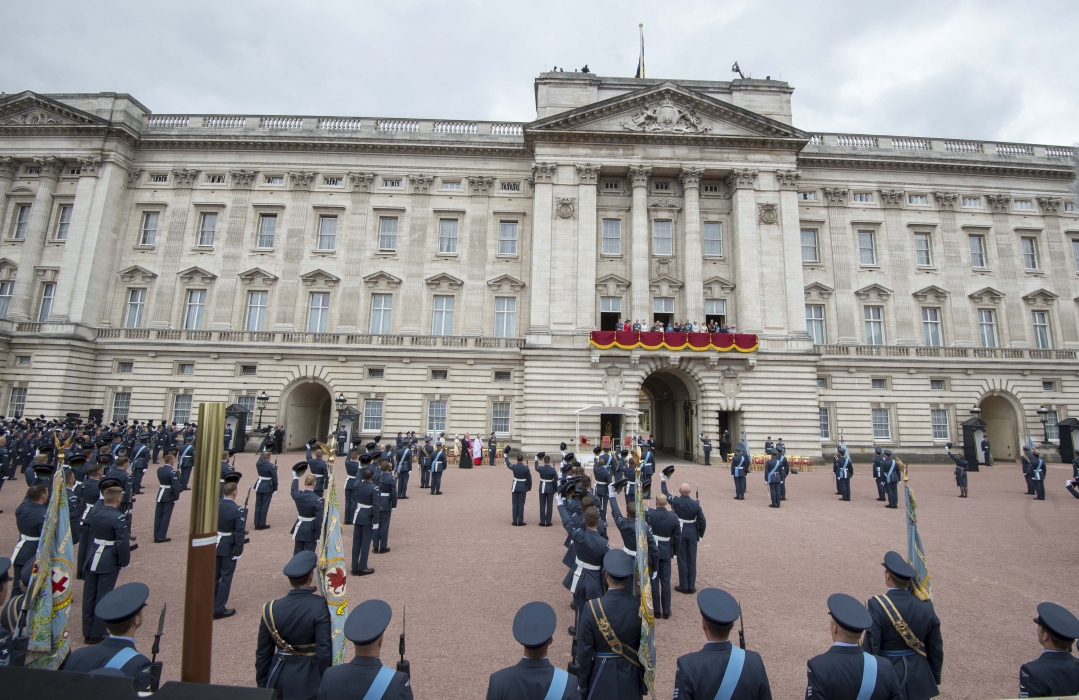
Today, Buckingham Palace is very much a working building and the centrepiece of the UK's constitutional monarchy, serving every bit the venue for many imperial events and ceremonies from entertaining strange Head of States to celebrating achievement at Investitures and receptions.
More than 50,000 people visit the Palace each year every bit guests to Country banquets, lunches, dinners, receptions and Garden Parties. Her Majesty also holds weekly audiences with the Prime Minister and receives newly-appointed foreign Ambassadors at Buckingham Palace.
Receptions are held at the Palace throughout the year to recognise the piece of work of industry, government, charities, sport, the Commonwealth and many more areas of life. For instance, in 2013 The Queen hosted a reception to celebrate the Commonwealth, Youth and Educational activity, which was attended by 350 guests from academic institutions around the world and included a performance by the Commonwealth Youth Orchestra and choir and more than recently, in 2015, Her Majesty hosted a reception for players, organisers and supporters of the Rugby World Cup.
Buckingham Palace is frequently a focal point for significant national celebrations and commemorations.
In 2002, a music concert was staged in the garden of Buckingham Palace to marker The Queen'southward Golden Jubilee, which included a unforgettable performance of 'God Save The Queen' by Brian May from the roof of the Palace and at Her Majesty'south Diamond Jubilee celebrations in 2012 members of the public were invited to have a special picnic in the Buckingham Palace garden.
The balustrade of Buckingham Palace is one of the nearly famous in the world. The first recorded Royal balcony advent took place in 1851, when Queen Victoria stepped onto it during celebrations for the opening of the Neat Exhibition. Since then, Imperial Balcony appearances accept marked many occasions from The Queen's annual official birthday celebrations to lookout the RAF Flypast at the end of Trooping the Colour, Royal Weddings, every bit well as special events of national significance such as the 75th ceremony of the Boxing of United kingdom of great britain and northern ireland.
Whilst Buckingham Palace is seen every bit the administrative hub of the Monarchy, it is also very much a family home, in addition to holding The Queen'due south Gallery and the Purple Mews. The Queen gave birth to Prince Charles and Prince Andrew at the Palace, and to this 24-hour interval notice of majestic births and deaths are notwithstanding attached to the front railings for members of the public to read. The christenings of The Prince of Wales, The Princess Majestic, The Duke of York and Prince William took place in the Music Room and many Royal Weddings take been historic at Buckingham Palace, most recently The Duke and Duchess of Cambridge'south.
The offices of those who support the 24-hour interval-to-solar day activities and duties of The Queen and The Duke of Edinburgh and their immediate family, such equally the Private Secretary'due south Office and the Privy Purse and Treasurer's Part are located at Buckingham Palace.
History of Buckingham Palace
George III bought Buckingham House in 1761 for his wife Queen Charlotte to use as a comfy family unit home close to St James's Palace, where many courtroom functions were held. Buckingham Business firm became known as the Queen'southward House, and 14 of George III's xv children were built-in there.
George IV, on his accession in 1820, decided to reconstruct the business firm into a pied-à-terre, using information technology for the aforementioned purpose as his begetter George Three.
Equally work progressed, and as tardily as the end of 1826, The King had a change of heart. With the assistance of his builder, John Nash, he set up about transforming the house into a palace. Parliament agreed to a budget of £150,000, but the King pressed for £450,000 as a more realistic figure.Nash retained the main block but doubled its size by adding a new suite of rooms on the garden side facing west. Faced with mellow Bath rock, the external style reflected the French neo-classical influence favoured past George IV.
The remodelled rooms are the Country and semi-State Rooms, which remain well-nigh unchanged since Nash's time.
The north and south wings of Buckingham House were demolished and rebuilt on a larger scale with a triumphal arch - the Marble Curvation - every bit the centrepiece of an enlarged courtyard, to commemorate the British victories at Trafalgar and Waterloo.
By 1829 the costs had escalated to near half a million pounds. Nash's extravagance toll him his job, and on the death of George IV in 1830, his younger blood brother William 4 took on Edward Blore to finish the piece of work. The King never moved into the Palace. Indeed, when the Houses of Parliament were destroyed by fire in 1834, the Male monarch offered the Palace equally a new home for Parliament, but the offer was declined.
Queen Victoria was the get-go sovereign to accept up residence in July 1837 and in June 1838 she was the showtime British sovereign to go out from Buckingham Palace for a Coronation. Her matrimony to Prince Albert in 1840 soon showed up the Palace'due south shortcomings.
A serious problem for the newly married couple was the absence of any nurseries and besides few bedrooms for visitors. The only solution was to movement the Marble Arch - information technology now stands at the north-e corner of Hyde Park - and build a fourth wing, thereby creating a quadrangle. The price of the new wing was largely covered by the sale of George Four's Royal Pavilion at Brighton.
Blore added an attic floor to the main cake of the Palace and decorated information technology externally with marble friezes originally intended for Nash'due south Marble Curvation. The work was completed in 1847.By the turn of the century the soft French rock used in Blore's East Front end was showing signs of deterioration, largely due to London's notorious soot, and required replacing.
In 1913 the decision was taken to reface the façade. Sir Aston Webb, with a number of large public buildings to his credit, was commissioned to create a new design. Webb chose Portland Stone, which took 12 months to prepare before building work could begin. When work did first it took 13 weeks to consummate the refacing, a process that included removing the old stonework.
The present forecourt of the Palace, where Changing the Baby-sit takes identify, was formed in 1911, as role of the Victoria Memorial scheme.
The gates and railings were also completed in 1911; the North-Eye Gate is at present the everyday archway to the Palace, whilst the Key Gate is used for Country occasions and the departure of the baby-sit after Changing the Baby-sit. The piece of work was completed but before the outbreak of the Showtime World War in 1914.
Visiting Buckingham Palace
Buckingham Palace is open to the public during the summer months and for a express number of tours in December, January and at Easter each twelvemonth. Discover out more about visiting the Palace on the Imperial Drove Trust website.
Source: https://www.royal.uk/royal-residences-buckingham-palace#:~:text=Buckingham%20Palace%20has%20served%20as,open%20to%20visitors%20every%20summer.
0 Response to "What's the Name of the Headquarters of the British Royal Family"
Postar um comentário